
Chronic inflammatory skin diseases such as psoriasis and hidradenitis suppurativa are strongly influenced by the cytokines IL-17A and TNF. While research has traditionally focused on epidermal keratinocytes, the contribution of dermal fibroblasts to these inflammatory processes has remained less well understood.
Aug 5, 2026
Beyond the Epidermis: Fibroblasts Emerge as Key Drivers of Skin Inflammation
Svraka et al. directly compared primary human dermal fibroblasts and keratinocytes from healthy donors. The cells were stimulated for 24 hours with IL-17A, TNF or a combination of both cytokines. Their responses were investigated using bulk RNA sequencing, pathway analysis and Western blotting. Dermal Fibroblasts Not Keratinocytes Dominate IL‐17A TNF‐Driven Inflammation Svraka et al 2026
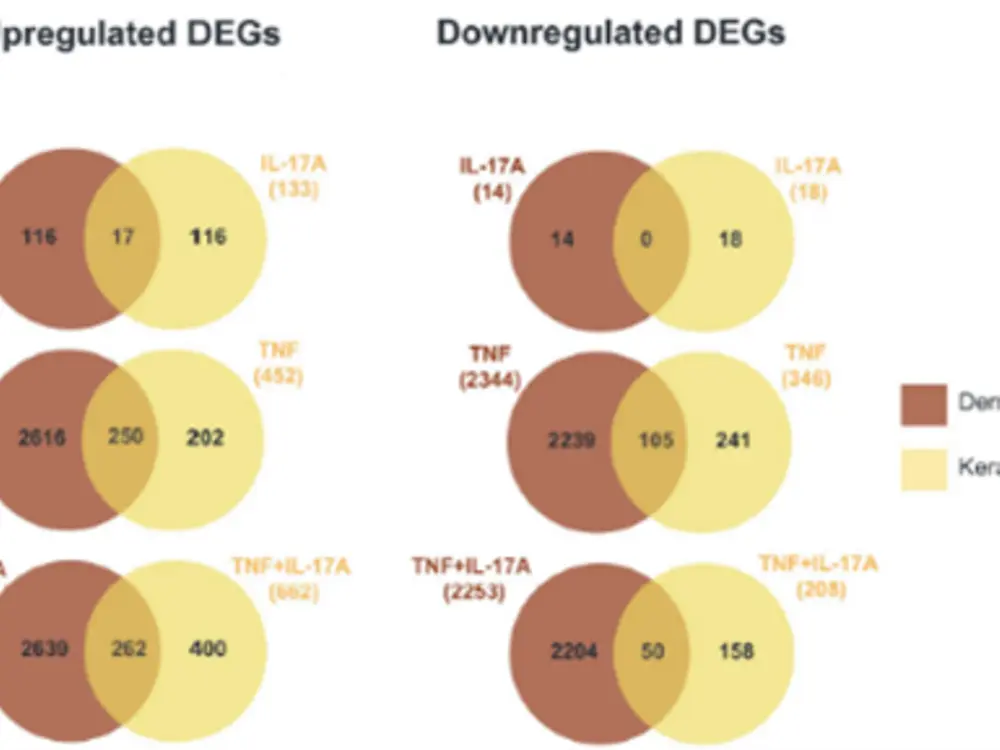
Dermal fibroblasts mounted a markedly stronger and broader inflammatory response than keratinocytes, particularly following TNF or combined IL-17A/TNF stimulation. TNF regulated 2,866 genes in fibroblasts, compared with 452 in keratinocytes. Under combined stimulation, 2,901 genes were differentially expressed in fibroblasts versus 662 in keratinocytes. Fibroblasts strongly activated immune-signalling and chemotaxis pathways and induced mediators such as CCL20, CXCL8 and IL6. Keratinocytes responded with a more epidermis-oriented programme involving differentiation, barrier defence and antimicrobial genes, including IL36G, S100A7A and DEFB4A.
The pronounced TNF responsiveness of fibroblasts was associated with substantially higher expression of TNF receptors, particularly TNFR2. Basal TNFRSF1B expression was approximately 21-fold higher in fibroblasts, and elevated TNFR2 protein abundance was confirmed by Western blotting. Although this relationship remains correlative, the findings identify dermal fibroblasts as active amplifiers of inflammatory signalling rather than merely structural cells.
These results underline why the dermal compartment should not be omitted from physiologically relevant in vitro skin research. By combining a differentiated epidermis with a fibroblast-populated dermal equivalent, Phenion® Full-Thickness Skin Models represent both major cellular compartments highlighted by the study. Compared with epidermal-only models, this more complete tissue architecture can capture complementary barrier-related and fibroblast-mediated responses, providing a more realistic and potentially more relevant platform for investigating skin physiology and complex inflammatory mechanisms.
Phenion® Full-Thickness Skin Models: because meaningful skin research goes beyond the epidermis.
Reference
Svraka L, Ben Abdallah H, Bertelsen T, Vestergaard C, Johansen C. Dermal Fibroblasts, Not Keratinocytes, Dominate IL-17A/TNF-Driven Inflammation. Experimental Dermatology. 2026;35:e70232. https://doi.org/10.1111/exd.70232 Dermal Fibroblasts Not Keratinocytes Dominate IL‐17A TNF‐Driven Inflammation Svraka et al 2026